The Most Expensive 1099 on Your Race Team
A 1099 is a tax form. It does not, by itself, make someone an independent contractor–and in North Carolina, that distinction can become very expensive when someone gets hurt.
Spend enough time around motorsports and eventually you will hear some version of: “They’re all contractors. We just 1099 everybody.”
Independent contractors absolutely have a place in racing. Teams routinely use consultants, specialists, engineers, fabricators, vendors, and other outside professionals.
But a 1099 is a tax form.
It does not, by itself, make someone an independent contractor.
And in North Carolina, that distinction can become very expensive when someone gets hurt.
A real-world example
A current North Carolina-based NASCAR and IMSA team advertises several positions as “Full-time · 1099 contract,” including mechanics, engineers, fabricators, a car chief, a hauler driver, and even a receptionist.
That does not mean those workers are misclassified. We do not know the full contracts, payment structure, equipment arrangements, outside clients, or actual level of independence.
But it is a good example of why motorsports organizations should look beyond the label.
One race mechanic position, for example, is described as full-time contract work involving car preparation, repairs, loading and unloading, inspection preparation, teardown, travel, and working the schedule required by the team.
That raises the right question:
Does the actual working relationship support independent-contractor status?
North Carolina looks at the relationship
North Carolina does not determine worker status solely by whether someone receives a W-2 or 1099.
The analysis can include questions such as:
- Who controls the worker’s schedule?
- Who determines how the work is performed?
- Who provides the equipment?
- Is the worker operating an independent business?
- Can the worker serve other clients?
- Is the person hired for a defined project, or filling an ongoing role in the organization?
North Carolina’s Employee Classification Section even asks about factors such as arrival and departure times, task direction, equipment, branded clothing, and how the worker is paid.
Those questions matter more than: “Did we issue them a 1099?”
Now imagine someone gets hurt
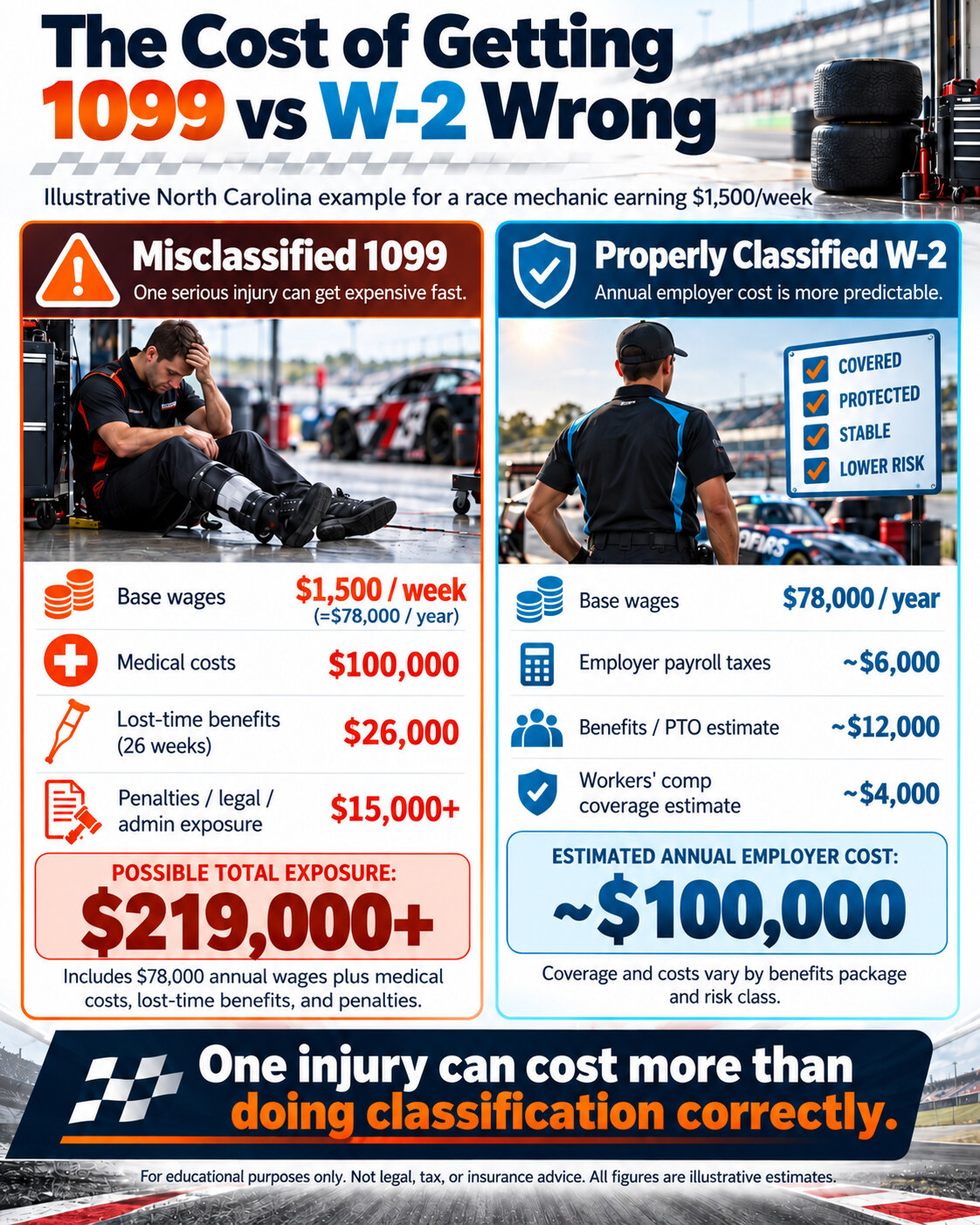
Suppose a race mechanic earns $1,500 per week and the team treats the mechanic as an independent contractor.
During shop preparation, the mechanic suffers a serious leg injury.
For illustration:
- Emergency care and hospitalization: $25,000
- Surgery: $35,000
- Imaging and follow-up care: $10,000
- Physical therapy: $15,000
- Prescriptions and equipment: $5,000
- Additional treatment: $10,000
That is already:
$100,000 in medical costs.
Then the mechanic is unable to work for six months.
At that point, one of the important questions may become: “Was this person really an independent contractor?”
If the worker was properly classified, the analysis goes one direction.
If the worker should have been treated as an employee, the team may now be defending that classification during a six-figure injury claim.
Why workers’ compensation matters
North Carolina generally requires businesses with three or more employees to carry workers’ compensation insurance, subject to certain exceptions.
That means classification can affect whether the organization even believes it is required to carry coverage.
A company may think it has 2 employees + 8 contractors when an examination of the working relationships could produce 10 employees.
That is no longer just a payroll issue.
It can become a workers’ compensation issue.
One injury can expose a much larger problem
The injured mechanic may also prompt a broader question:
How are everyone else doing similar work classified?
Imagine a race organization with 8 contractors × $75,000 = $600,000 in annual contractor compensation.
If several of those workers should actually be employees, the potential exposure can expand beyond one injury into:
- Workers’ compensation
- Payroll taxes
- Unemployment insurance
- Wage-and-hour compliance
- Employment records
The money supposedly saved by using contractors can disappear quickly.
Racing makes this especially complicated
Race teams often have employees and legitimate contractors working side by side.
A team may use:
- Full-time shop employees
- Traveling crew
- Engineers
- Specialty contractors
- Fabricators
- Transportation providers
- Weekend personnel
- Consultants
- Vendors
Some may properly be independent contractors.
Others may function like regular employees.
The right answer is not automatically: “Everyone is 1099.”
And it is not automatically: “Everyone must be W-2.”
The relationship has to support the classification.
Ask the better question
Instead of asking: “Can we make this position 1099?”
Ask:
“How will this person actually work?”
Who controls the schedule? Who controls the work? Whose equipment is being used? Is this an independent business serving multiple clients, or someone filling an ongoing role inside your organization?
Those answers matter much more than the form issued at the end of the year.
The cheapest contractor can become the most expensive employee
Worker classification feels like paperwork when everything is going well.
It becomes much more important after:
- An injury
- An unemployment claim
- A wage complaint
- A tax examination
That is a poor time to discover that the working relationship does not match the classification.
At t10HR, we help motorsports organizations review these relationships before they become expensive problems.
Because the goal is not to eliminate contractors.
It is to make sure that when you call someone a contractor, the facts support it.
This article is intended for general HR and risk-management education and is not legal, tax, insurance, or workers’ compensation advice. Worker classification depends on the facts and circumstances of each relationship.
Not sure your contractor relationships would hold up to a closer look? t10HR can help review them before they become expensive problems.
Talk to t10HR →